Try again
In the summer of 2000, Aaliyah’s “Try Again” jumped to number one on the Billboard Hot 100 during the week of June 17. It was the first song in the chart’s history to reach the top based solely on radio airplay. No commercial single. No physical release. Just the song, everywhere, all at once. The chorus was simple:
If at first you don’t succeed
Then dust yourself off and try again
The following year, Ben Affleck and Jennifer Lopez met on the set of Gigli. By 2002 they were engaged. By 2003 they had postponed the wedding. By January 2004 it was over. Seventeen years later, they tried again. Married in Las Vegas, July 2022. Lopez filed for divorce on their second anniversary. The fundamental incompatibilities survived the intermission.
One year after Aaliyah’s chorus topped the charts and Bennifer became a thing, the Surface Transportation Board finalized EP 582, a set of rules governing major railroad mergers. The rules were written because the last attempts at consolidation had gone catastrophically. The message was the opposite of Aaliyah’s: if at first you don’t succeed, maybe stop trying.
Same chorus
Nostalgia is a hell of a business case. You don’t have to build something new; you just reassemble what you remember working. Affleck and Lopez skipped seventeen years of growing apart and bet that the chemistry was the foundation, not the context. The railroad industry has been making the same bet for over a century.
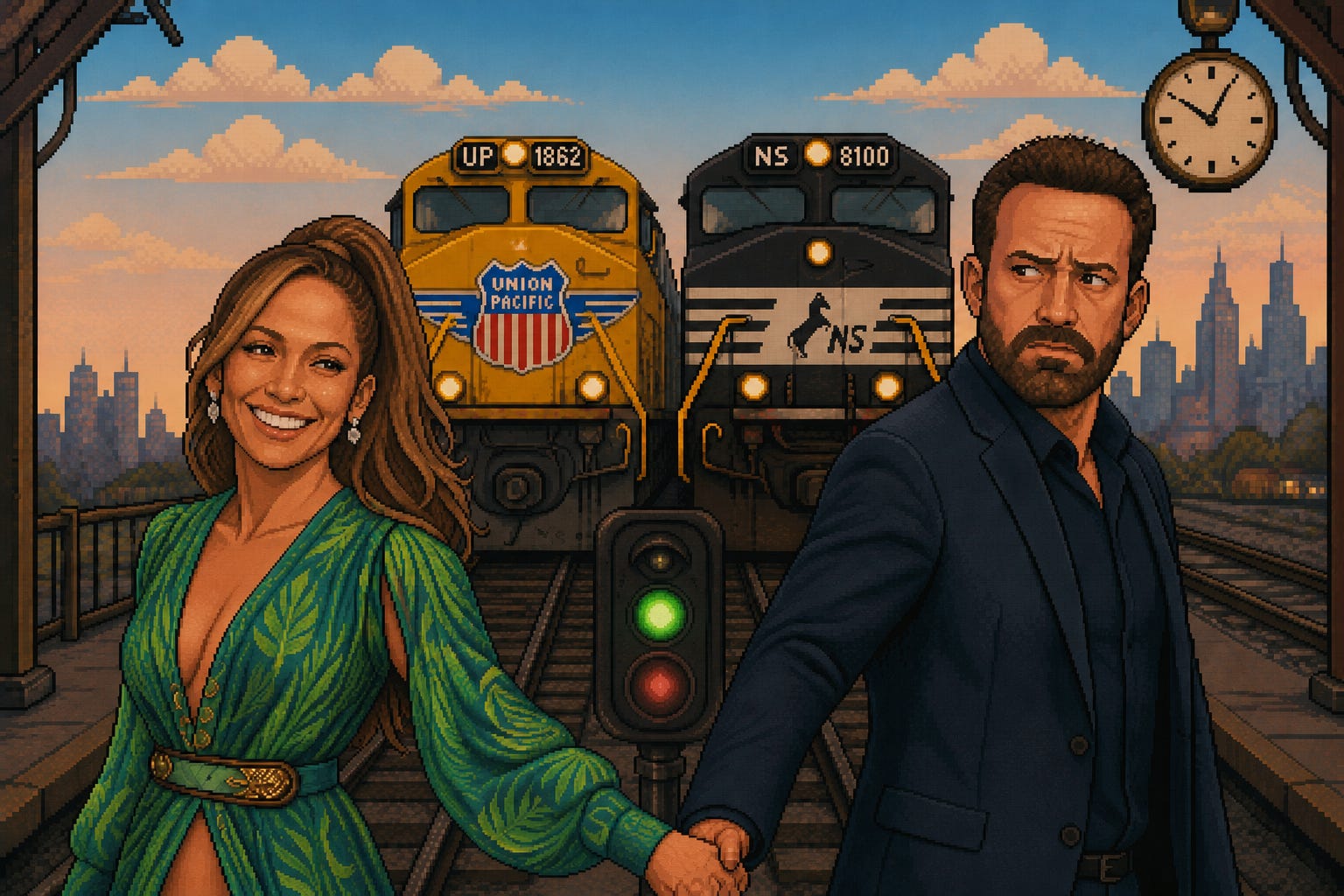
Trains occupy a peculiar space in the American imagination. We romanticize the steel network in a way that is hard to articulate; cars often feel too isolationist, planes too corralling. Maybe it is the grittiness of the westward expansion, the opulence of the Orient Express, or the reflective notion of midnight freight rolling through idle towns. That romance persists even as the industry has consolidated from dozens of roads down to six major systems in North America, each carving out territories that would make the original tycoons jealous. Union Pacific’s proposed acquisition of Norfolk Southern is being framed as the ultimate expression of this ideal: a true coast-to-coast system, 50,000 miles of track, single-line service from Virginia to California. Like Bennifer’s second engagement, the ring is bigger this time. The promises are grander. The question is whether the underlying relationship has actually changed.
For some, the introduction of the network effects starts young, on cardboard via a game interestingly titled Monopoly. The real irony here is that Parker Brothers patented the game in 1935 when dozens of rail carriers crisscrossed the country. Something about the number four stuck and it is intriguing that the number on the map could shift and the board might need an update.
Look, it makes sense. The logic is seductive. The appeal of consolidation is evergreen. The industry’s history proves it never loses its grip. End-to-end mergers can eliminate interchange delays, reduce car handling, and theoretically improve service. We will hear this framing positioned similar to other consolidation appeals: fewer handoffs, unified systems, seamless customer experience. The pitch is always compelling on slides. Airlines learned the limits in the years following deregulation. Hospitals learned it when rural facilities started closing. Technology platforms learned it when the everything-app vision contracted to core competency. The pattern is consistent enough to qualify as a lesson, but desires and operational reality rarely share the same timetable.
The reunion
Jennifer Lopez once described getting back together with Affleck as proof that “real love does exist.” The U.S. airline industry has expressed similar optimism at least four times, too.
Delta absorbed Northwest in 2008. United merged with Continental in 2010. American combined with US Airways in 2013. Alaska acquired Virgin America in 2016. The JetBlue-Spirit merger was blocked in January 2024, the first major airline combination rejected by federal courts in decades, after Judge William Young ruled it would “do violence to the core principle of antitrust law.” Each deal arrived with the same up and to the right charts.
What was most interesting was the language used at the time to justify the consolidation thesis, specifically one word: growth. When Delta CEO Richard Anderson testified before Congress in 2008, he described the Northwest merger as “about addition, not subtraction” and hinted at adding international routes from Memphis. By September 2013, Delta had eliminated the Memphis hub entirely, reducing daily departures from 240 to roughly 60. Cincinnati dropped from 670 daily flights to 170. Cleveland, where United pledged to maintain 90% of pre-merger flight levels, saw its hub closed in 2014. St. Louis fell from 30.5 million annual passengers to under 12 million. Setting aside pre and post 2020 demographic and population shifts, the network combination clearly led to network rationalization.
Yet, it is not just a question of which customers you may or may not serve; equal weight needs to be given to the customer experience during and after the transition. Many may not remember, but United’s March 2012 reservation system cutover to Continental’s platform produced something far worse than a meltdown. Kiosks failed, center wait times spiraled. Boarding passes had to be written by hand. The DOT eventually fined the airline $350,000 for delaying over 9,000 refund requests.
Ultimately, growth comes in many forms: passengers and shipments, of course. But the most interesting leverage on airline balance sheets actually developed in a new manner: loyalty programs. Without these revenues, every major U.S. carrier would operate at negative margins. Delta’s 10.5% operating margin drops to negative 2.5% excluding SkyMiles revenue. United falls from 8.9% to negative 1.9%. American plunges from 4.8% to negative 8.3%. Delta alone collected $7.4 billion from American Express in 2024, with a stated goal of reaching $10 billion annually. That represents nearly 30% of revenue and approximately half of operating profits from a credit card partnership.
Airlines promised operational excellence but delivered loyalty programs. J.Lo became one of the most successful entertainers of her generation not because any single chapter went according to plan, but because the brand outlasted every storyline. Airlines followed the same arc. They look more like banks that happen to have assets in the sky.
And then there is Spirit. The airline that was supposed to be saved by trying again with JetBlue. Judge Young blocked the deal in January 2024. Within ten months, Spirit filed for bankruptcy. It emerged, restructured, and filed again. The airline hadn’t turned a profit in seven years. Its market share collapsed from 5.1% to a projected 1.8%. Last week, Spirit ceased all operations and entered liquidation. The first major U.S. airline to shut down in twenty years. Aaliyah sang that if at first you don’t succeed, you dust yourself off and try again. Spirit dusted itself off three times. It is worth keeping in mind as we discuss what happens to the acquisition target if this railroad merger doesn’t close.
Seven thousand pages of aspiration
The original application ran 6,000 pages. What we had was less an explanation of value and more an extended exercise in justification: how to make “bigger is better” sound something like improved service. The challenge wasn’t length; it was absence. One of the most revealing sections in the entire filing was the concessions page. Blank. Completely empty. Either a power move or a fatal miscalculation.
The STB’s answer came on January 16: incomplete. Not rejected outright, not approved with conditions. Ultimately, the Board found the competitive analysis “internally inconsistent” with UP’s own growth projections. You can’t promise regulators 15 - 26% traffic growth in your business case and then assume nothing changes in your market share model. In a fixed network operating model, the growth you promise becomes the market power your opponents are warning about.
Four months later, UP came back. The revised version, filed last week, clocks in at 7,030 pages. UP says it now uses 100 percent of actual traffic data from all six Class I railroads for the first time in merger history. The claimed shipper savings went up to $3.5 billion annually. They agreed to divest the Terminal Railroad Association of St. Louis. Union job creation estimates increased from 900 to 1,200. These are all interesting points for an industry that has propped up its operating ratio on efficiency and pricing gains.
But the details cut the other direction. Capital improvement spending dropped from $1.023 billion to $923.3 million. Somehow the projections went down, but the promises went up. Spend less, claim more. For shippers who have spent years hearing “growth” on earnings calls while experiencing service reductions and accessorial increases, this is a familiar arithmetic.
The STB’s 2001 merger rules are explicit: applicants must demonstrate that a proposed combination will preserve and enhance competition. Preserve is the floor. Enhance is where it gets interesting, because the regulation hasn’t been applied to a single merger in twenty-five years. (The CPKC merger was reviewed under the older, less stringent standard.) That test asked whether harms could be “offset” by public benefits. The new test asks whether the system gets more competitive. For an industry that has consolidated from over forty carriers to six, proving that five is better than six is a remarkable burden.
The Board anticipated this exact argument. “Competition in product and geographic markets can also be eliminated or reduced by mergers, including end-to-end mergers.” UP’s case rests on the premise that end-to-end equals no harm. The Board rejected that premise a quarter century before UP made the argument.
The regulation is on trial, not just the merger. If the Board approves with weak conditions, EP 582 is a dead letter and further consolidation is inevitable. If the Board rejects, EP 582 becomes the permanent ceiling. Either outcome reshapes the industry for a generation.
Trying again
Four months of rework and a few hundred million in legal fees later, UP is undeterred. Jim Vena’s contempt for lawyers is well-documented, which makes the billable hours all the more ironic.
Meanwhile, every other railroad is running scenarios. Rationalizing, holding capital, and jockeying the balance sheets. What was intriguing to see: a coalition including BNSF, CPKC, the Farm Bureau, the Chemistry Council, the Teamsters, and the National Industrial Transportation League launched the day before the revised filing.
And then the real surprise: Schedule 5.8. The merger agreement’s walk-away terms, which were originally withheld from regulators and are now public. You learn more about a marriage from the prenup than from the wedding vows. UP will forfeit $2.5 billion rather than accept widespread trackage rights or line sales. It can absorb Board-imposed conditions up to $750 million in cumulative budget. Above that, the deal unravels.
This is an $85 billion deal. UP would pay $2.5 billion to walk away rather than let competitors use its tracks. The public case is that this merger enhances competition. The walk-away terms say competitive access is the one thing that kills the deal. That point, in and of itself, lessens the weight of reciprocal switching as a counter proposal.
UP CEO Jim Vena, on the recent earnings call:
We’re not prepared to really give concessions to the level that basically just opens up our railroad for no reason at all other than they want to gain something through this process.
If the merger genuinely enhanced competition, sharing routes would reduce value modestly, not fatally. The efficiency gains from eliminating interchange friction would persist regardless. The thing UP protects most carefully is the thing it claims doesn’t matter: network exclusivity.
And then there is Norfolk Southern. Mark George, its CEO, stood in front of a visualization of rail volume at the ASLRRA meeting in Minneapolis last month offering something CEOs almost never say in public.
Every year, we build and present to our board a five-year growth projection. We always put forward a hockey stick of where we think our growth is going to go. Every stinking year. But the black line doesn’t really move. This is our problem as an industry.
You have to respect that level of candor and awareness. However, in acknowledging that prior mergers were “screwed up” there is still an argument being made that, somehow, this time is uniquely different. Jennifer Lopez and Ben Affleck certainly made similar comments. Yet, asking the STB to look past the same integration pain that caused the rules without a true plan to address material volume gains is, well, a position.
If this doesn’t close, there is a massive inflow of capital to an account in Atlanta. That buys time. It doesn’t buy a strategy. In effect, Mark George framed the problem as structural and the merger as the fix. If the fix doesn’t come, the structure doesn’t change, and NS will have spent two and a half years waiting for an answer that didn’t arrive. Spirit Airlines reminds us how that can end. To be clear, Norfolk Southern is not Spirit. It is an enduring franchise where inspired and crafty team members show up at all hours to move the goods that power the economy. It will not vanish. But a company that has agreed to stop being itself for two and a half years doesn’t just resume a growth trajectory.
Diverging approach?
The Board has roughly thirty days from the April 30 filing to decide whether to accept the revised application. If it does, a review lasting more than a year begins, with a decision potentially occurring in mid-2027.
What should shippers be watching? Whether the revised market share projections actually project or just repackage the same static snapshot. Whether UP shows any flexibility on the walk-away terms. Whether remedies with real teeth emerge from the proceeding: expanded trackage rights, reciprocal switching, open gateways, rate protections for captive shippers who currently have two options and would wake up with one.
Aaliyah’s song persisted without a physical release. No format, no packaging, just the work itself. EP 582 has persisted without a case. No test, no precedent, just the standard. Affleck and Lopez came back with more maturity, more resources, and the full benefit of hindsight. A bigger ring, different terms, yet the divorce still came two years later.
Growth on paper and growth on the ground remain very different things. The industry is trying again. The cake is thicker. The concessions page is no longer blank. The couple says this time is different. But, the officiant has never performed this ceremony. Twenty-five years is a long time to hold your peace. Fortunately we won’t have to wait nearly as long to dust ourselves off.